System of Systems
3 Sets is the smallest system. Everything else is built on top.
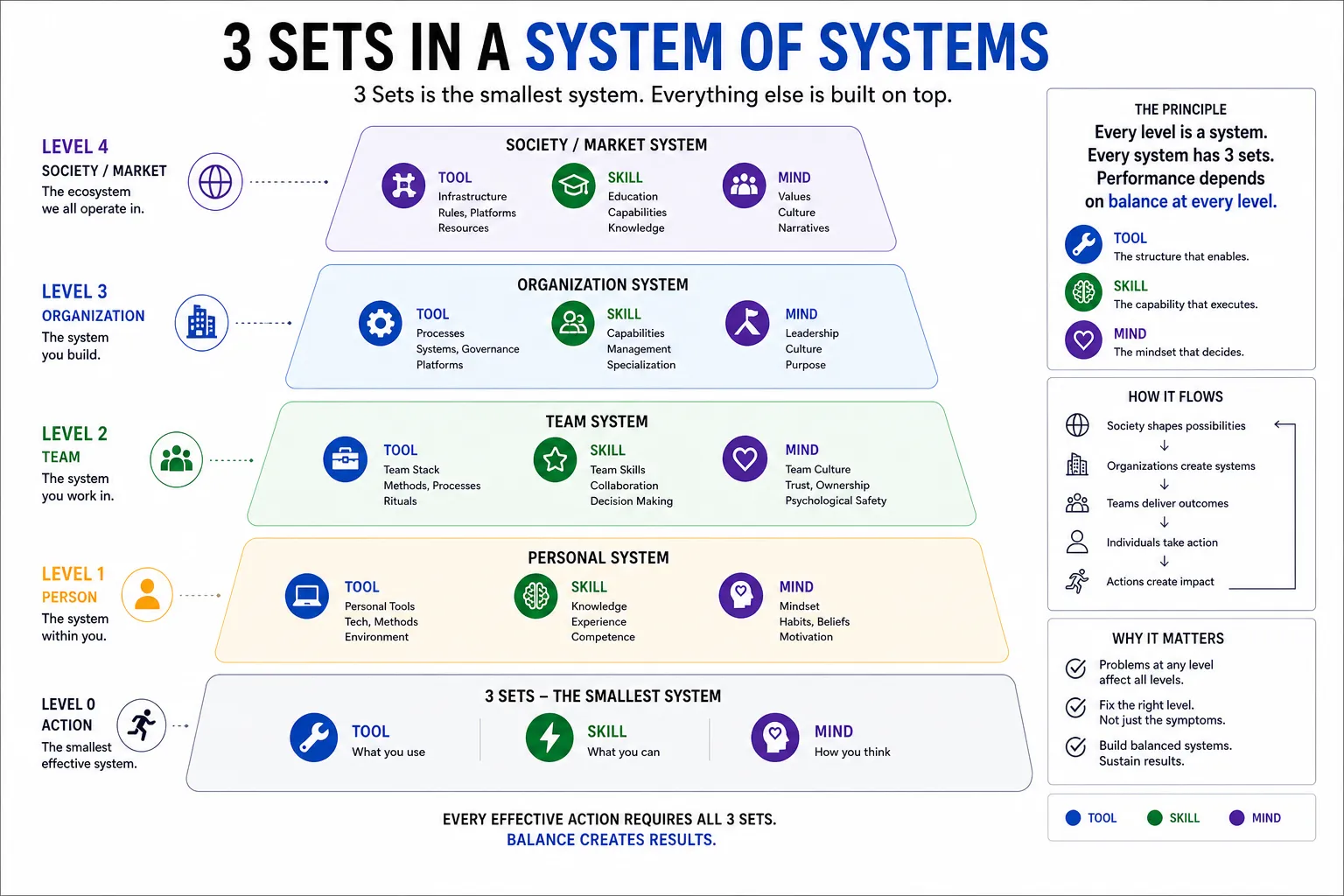
The 3sets Method doesn't just describe individual effectiveness — it scales across all system levels. Each level has its own Tool-Sets, Skill-Sets, and Mind-Sets. And each level influences those above and below.
3 Sets — The Smallest System
You yourself
The personal interplay of tool, skill, and mind. The basic unit of all effectiveness.
Personal System
The system you are
Your extended personal environment — habits, relationships, life design.
Team System
The system you work in
The team you work in. Shared tools, shared skills, collective beliefs.
Organization System
The system that shapes you
The organization that shapes teams. Structures, policies, corporate culture.
Society / Market System
The system we all operate in
Society, regulation, markets. The system everyone operates in.
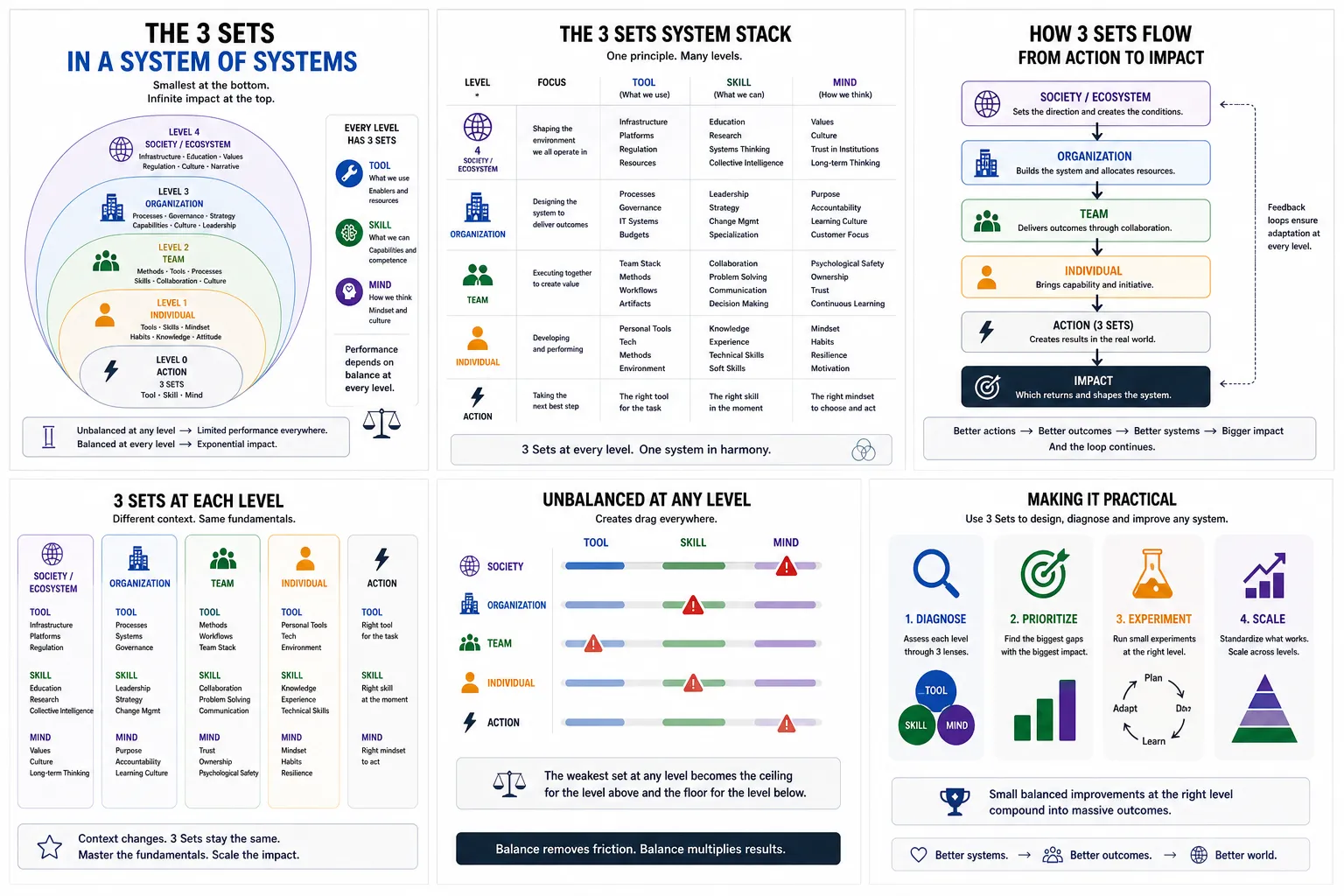
How It Scales
A structural property of the method — the same pattern at every level.
- Every level is a system.
- Every system has 3 sets.
- Performance depends on balance at every level.
- On higher levels the Setting dominates (Principle 3): incentives, structures, narratives.
How It Flows
- Imbalance at any level limits the impact.
- Balance at one level lifts the one above.
- Change must target the right level.
- Setting interventions become disproportionately powerful on higher levels.
Making It Practical
- Start at Level 0: Your own 3 Sets.
- Diagnose the level, not just the symptom.
- Small interventions at the right level beat big ones at the wrong level.
Imbalance limits results — at every level. Balance lifts the ceiling.
At which level is your bottleneck?
The diagnosis helps you find the weakest set — but you choose the system level.