The Method Explained
Every effective action requires the interplay of Tool-Set, Skill-Set, and Mind-Set. Within each, individual contribution (set) and structure (setting) work together. The weakest dimension limits the outcome.
The One-Third Problem
Most people, teams, and organizations only ever optimize one dimension:
- T They buy new tools — but don't learn to use them.
- S They collect skills — but have neither tools nor belief to apply them.
- M They talk about mindset — but change neither structures nor abilities.
The result: They invest a third and expect the whole.
Typical pattern: Tool over-investment, skill and mindset deficit
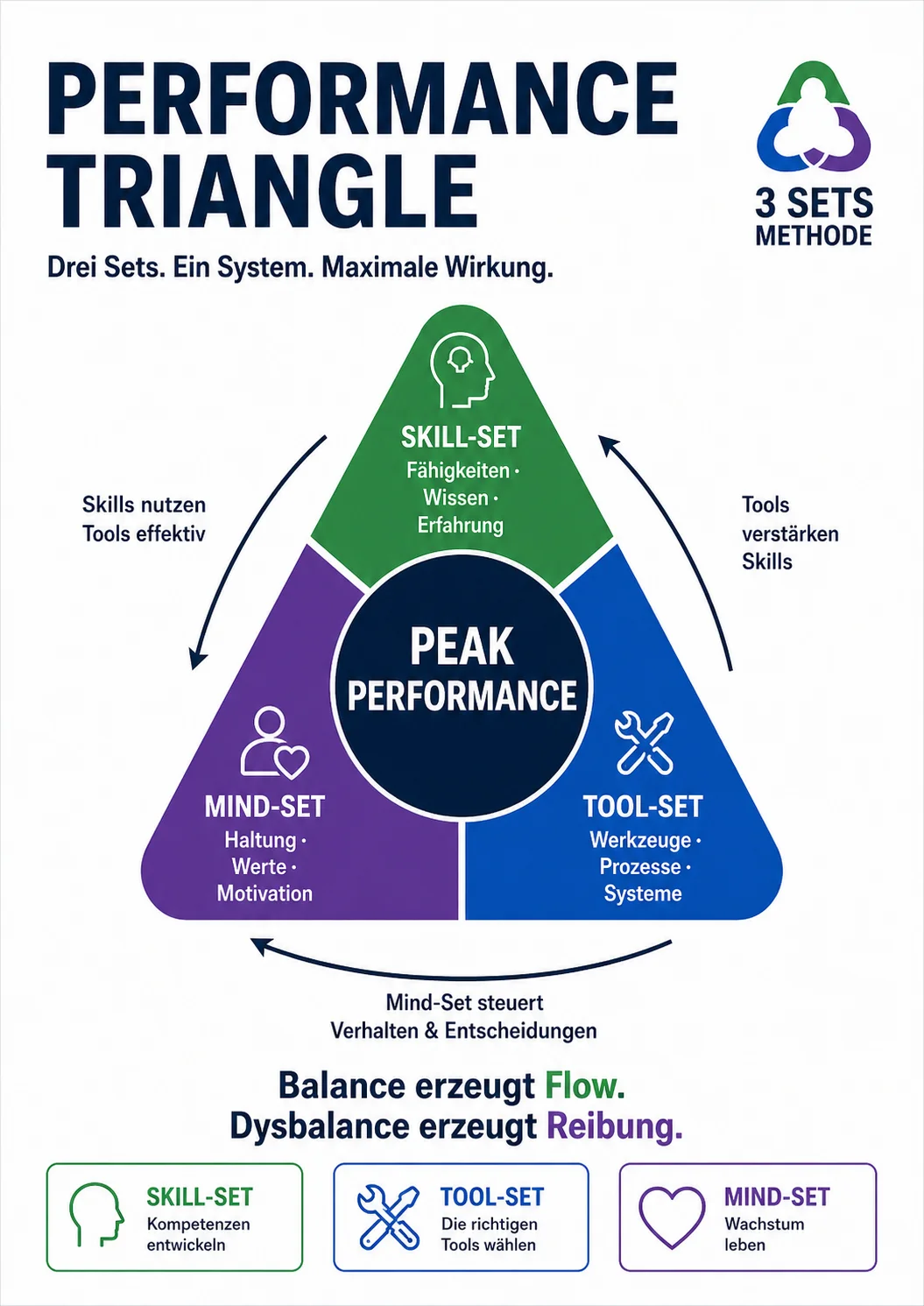
The Chain Heuristic
Your outcome is capped by your weakest set — like a chain that breaks at its weakest link (Liebig's Law of the Minimum).
Example on the 1-5 scale: Tool 5, Skill 5, Mind 2 — your outcome is capped at level 2. Investing in the strongest set does not raise the cap. The chain is a direction-finder, not a formula — a formal interaction model (threshold-multiplicative with alignment factor) is a research hypothesis, not part of the specification.
The Three Dimensions
Tool-Set
Definition: External aids that structure, enable, or constrain your actions. Exist independently of you.
Test: "If I disappear — does it still exist?" If yes → Tool.
Examples: Software, hardware, methods (Scrum, OKRs), processes, spaces, contracts, infrastructure.
The Tool Trap
- • Tool overload (dozens of SaaS apps per knowledge worker on average)
- • Tool fetishism (tool becomes end in itself)
- • Tool determinism ("hammer sees nails")
Skill-Set
Definition: Abilities that exist within you and can be demonstrated through action. Require practice to develop.
Test: "Can this be observed through performance?" If yes → Skill.
Examples: Expertise, communication, conflict resolution, learning strategies, metacognition.
The Skill Trap
- • Skill accumulation without integration
- • Skill-gap fixation (deficit thinking)
- • Theory-practice gap (regular failure to transfer learning into action)
Mind-Set
Definition: Beliefs, assumptions, and mental models that filter perception and shape interpretation. Often unconscious.
Test: "Does this determine what counts as relevant, true, or possible?" If yes → Mindset.
Examples: Growth vs. fixed mindset, beliefs about own abilities, systems thinking.
The Mind-Set Trap
- • Mindset as label instead of attitude
- • Culture change without structure
- • Positive affirmation without practice
The Three Principles
Your weakest set limits your outcome
Like a chain that breaks at its weakest link. It doesn't matter how excellent your Tool-Set is if your Skill-Set is missing.
→ Always invest in the weakest set.
Alignment beats individual excellence
Three mediocre but aligned sets beat three brilliant but isolated ones.
→ Treat a single-dimension intervention as a hypothesis to test, not a default.
Every set has an inner Set/Setting split
Within each of the three sets, individual contribution (Set) and structure (Setting) work together. A strong Set in an incongruent Setting evaporates; a thoughtful Setting without a corresponding Set is form without function.
→ Always ask: Set or Setting?
Set and Setting — the inner dimension
Set is what you carry. Setting is what surrounds you. Both operate within each of the three sets — and only together produce performance. Concept transferred from Zinberg (1984).
Set (contribution)
The tool itself: functions, interaction logic, built-in assumptions about good work.
Setting (Structure)
Integration environment: position in the tool stack, governance, interfaces, canonical place.
Set (contribution)
The competence itself: declarative knowledge, procedural skill, meta-competence.
Setting (Structure)
Learning architecture: task world, feedback structure, conditions of application.
Set (contribution)
The attitude itself: implicit beliefs, mental models, individual contribution.
Setting (Structure)
Social structure: incentive systems, status logic, narratives, feedback processes.
Setting is not a fourth dimension. It is a layer within each set. On higher system levels (team, organization, society) it increasingly dominates.
The Four Values
Non-negotiable. Undermining them means practicing something else.
Diagnose before solution
First understand which set limits — then act. Not the other way around.
Action before perfection
First diagnosis in minutes, then do. Months of analysis just swaps systems.
Weakest set first
Investment goes into the uncomfortable, not the pleasant.
With-the-system, not against-the-person
Performance arises from system alignment. Recurring problems indicate a system problem, not a people problem.
The Five Attitudes
How to use the method — not what it says.
Good enough beats perfect
Perfection is the most elegant form of procrastination.
Method is a tool, never a purpose
No cult. If you spend more time on the triangle than on living — stop.
Rhythm beats intensity
Quarterly diagnosis and adjustment. No continuous optimization.
Not every problem is a 3sets problem
Sometimes the problem is power, structure, health, or bad luck.
In the end, action is what counts
Elegant diagnosis without action is worthless.
Diagnose · Intervene · Measure · Learn
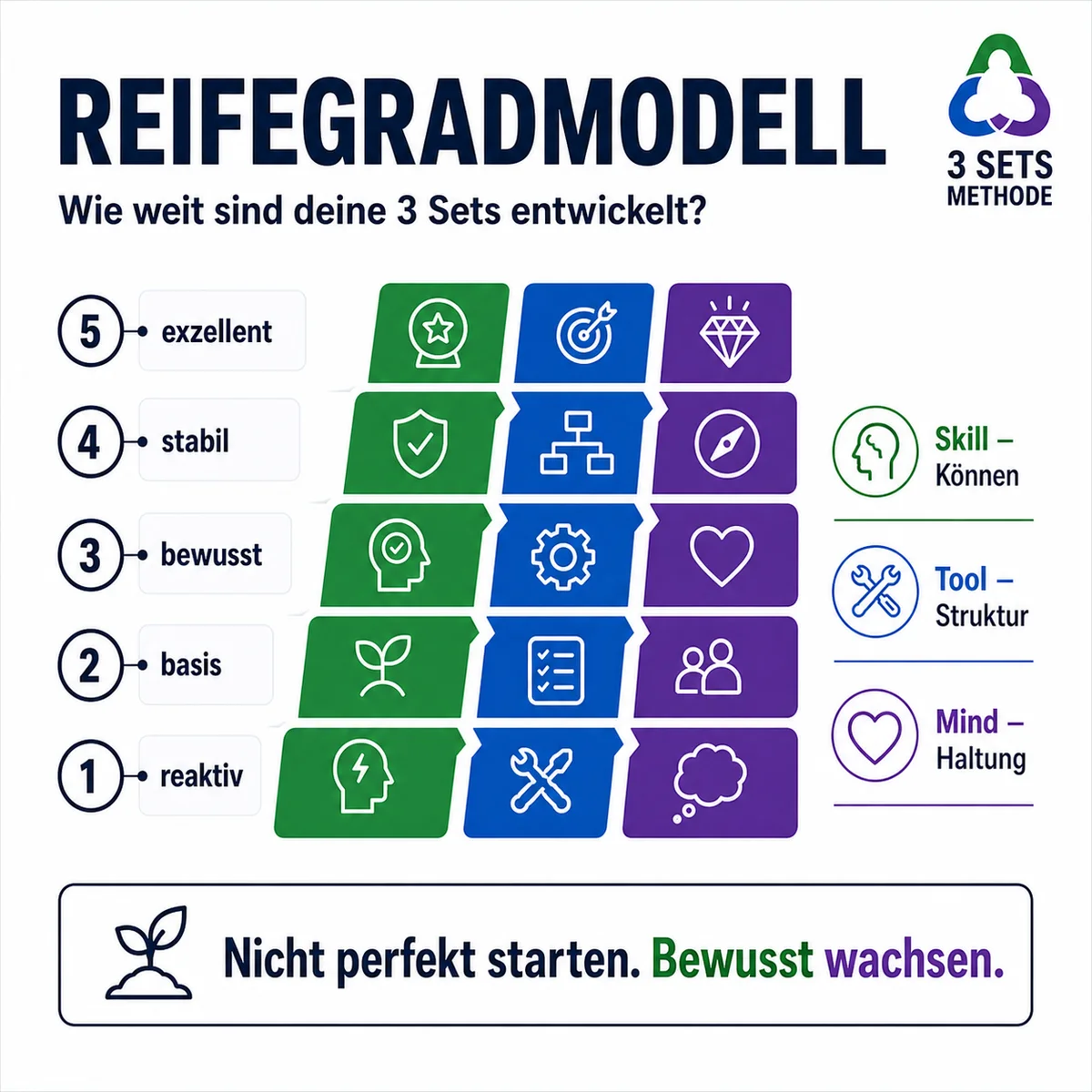
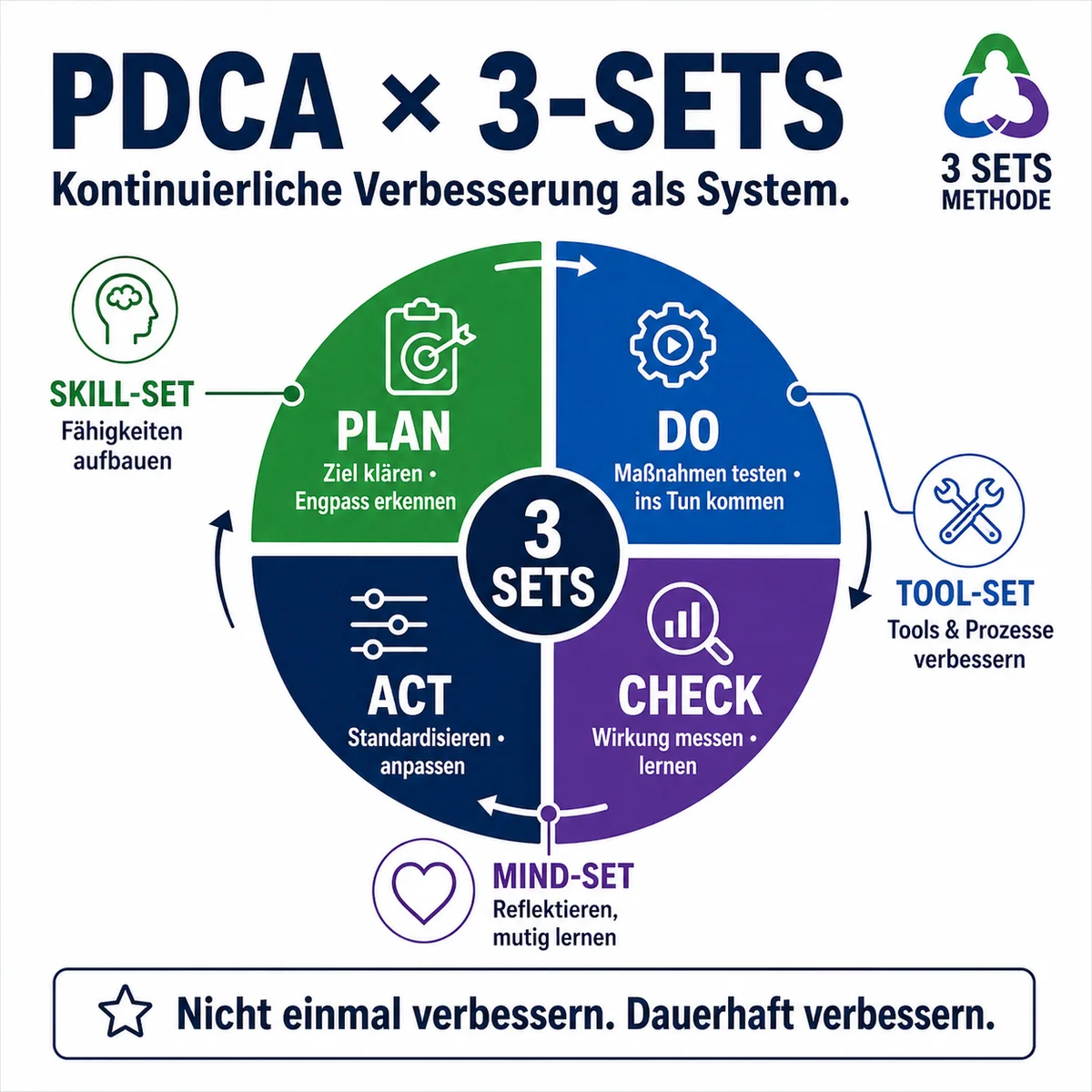
The 3sets Method isn't a one-off workshop — it's a PDCA cycle. Diagnose before intervening, small action, fast measurement, honest learning. Then again.
The strongest interventions link all three sets. Pure tool-fixes without skill and mind usually fizzle within weeks.
Which Set is Affected?
Classify by the nature of the lack — not by the intervention that would fix it.
If the solution is:
Access to an artifact, structure, or process is missing
→ Tool-Set
If the solution is:
A capability that could be taught and practiced is missing
→ Skill-Set
If the solution is:
A belief, assumption, or perception is missing or wrong
→ Mind-Set
Early readers on the 3sets Method
What Readers Say
"Finally an explanation for why my new tools never work as expected. The Tool-Set isn't the problem — I was."
"After 3 productivity courses with no results, the diagnosis showed me: my Mind-Set sabotages everything. Now I'm working on it."
"The one-third problem explains why our team doesn't perform despite the best equipment. We have the skills — but not the structure."
Based on early reader feedback. Full testimonials after book publication.
Find your weakest set
The 3sets Inventory gives you a first hypothesis in 5 minutes — a Quick-Check (depth 1). A robust diagnosis takes depth 2 or 3 (see the specification). Heuristic instrument, psychometric validation in progress.